

Henyuan Medical: Your Trusted 1 Crank Hospital Manual Bed Suppliers
When it comes to reliable manual hospital beds, Henyuan Medical stands out as a leading supplier of 1 crank hospital manual beds. These beds are designed for home care, clinics, and healthcare facilities, offering adjustable, durable, and cost-effective solutions.
In this comprehensive guide, we explore everything you need to know about single crank hospital beds, from technical specifications to practical buying tips, and compare them with multi-crank options.
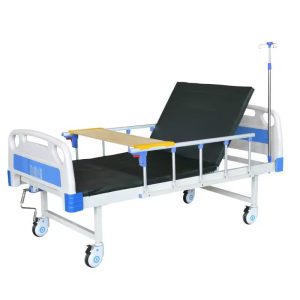
What is a 1 Crank Hospital Manual Bed?
Key features
-
One crank:The single crank controls the elevation of the backrest, typically from a flat position up to an incline of about
-
Manual operation:A caregiver must use the crank to adjust the position, unlike an electric bed with push-button controls.
-
Fixed height:The overall height of the bed is fixed, which is convenient for transfers from wheelchairs and other mobility aids.
-
Basic but functional:These beds are considered a budget-friendly and reliable option, making them suitable for a variety of medical environments.
-
Standard components:They often include durable steel frames, detachable head and footboards, and wheels with locks for stable and secure positioning.
A 1 crank hospital manual bed is a manually adjustable bed operated by a single crank mechanism. Unlike electric beds, these beds do not require power, making them ideal for home care, small clinics, or areas with unreliable electricity. The single crank typically controls the bed’s head elevation, which allows patients to sit up comfortably for reading, eating, or therapy.
Key Features of Henyuan Medical 1 Crank Beds:
| Feature | Specification |
|---|---|
| Material | High-grade steel frame |
| Maximum Load | Up to 250 kg |
| Adjustments | Head section via single crank |
| Side Rails | Optional detachable rails for safety |
| Dimensions | Standard 2000 x 900 mm (customizable) |
| Mattress Type | Compatible with standard hospital mattresses |
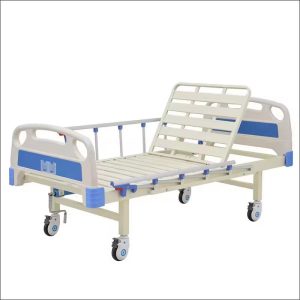
Advantages of Single Crank Manual Beds
Cost-effectiveness
- Lower upfront cost: Manual beds are generally cheaper to purchase than electric models.
- No energy costs: They do not require electricity, saving on operational costs.
Reliability and functionality
-
Works without power:The manual crank system functions regardless of power outages or limited electricity access.
-
Durable and low-maintenance:With fewer mechanical parts, they have a lower risk of motor failure and are easier to maintain and repair.
Ease of use and portability
-
Simple to operate:The hand-crank mechanism is intuitive, requiring minimal training for caregivers.
-
Easy to move:Manual beds are often lighter and easier to move, making them a good option for home use or smaller spaces.
-
Adjustable positions:The crank allows for manual adjustment of the backrest to help patients sit up or find a more comfortable position.
-
Affordability – Single crank beds are significantly more cost-effective than electric or 2/3 crank models, making them an excellent choice for bulk procurement.
-
Ease of Use – The manual crank system is straightforward, requiring minimal effort to adjust the bed’s position.
-
Durability – Henyuan Medical beds are made of heavy-duty steel, ensuring long-term use without frequent maintenance.
-
Safety – Optional bed handrails provide additional safety for patients, reducing the risk of falls.
-
Portability – These beds are lightweight and easy to transport, suitable for clinics, rehabilitation centers, and home care setups.
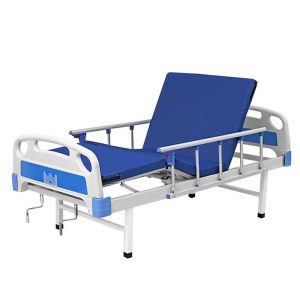
Practical Case Study: Henyuan Medical Beds in Home Care
- Patient profile: An elderly individual recovering from a minor procedure, such as a knee replacement. They require an adjustable backrest for comfort and to assist with sitting up to eat or watch television but do not need frequent repositioning or bed-height adjustments. A family member is the primary caregiver.
- Selection rationale: A single-crank bed is chosen because it is significantly more affordable than an electric model and serves the patient’s primary needs for an adjustable backrest. Since a family member is available to perform the crank adjustments, the physical effort required is not a barrier.
- Outcome: The bed effectively provides the necessary comfort and positioning. The patient is able to recover at home, and the family avoids the high cost of a more complex bed. This works well for the short-term recovery period where the patient’s mobility is expected to improve.
Nursing home facility with budget constraints
- Facility profile: A long-term care facility needs to replace several beds but has a limited budget. A single-crank model is selected for residents who are more mobile or have stable medical conditions that do not require complex positioning.
- Selection rationale: The facility prioritizes the durability and cost-effectiveness of manual beds. They allocate their budget for more advanced, electric beds for residents with higher needs, while manual beds suffice for others. This strategy allows the facility to maintain a high standard of care while managing finances effectively.
- Outcome: The single-crank beds provide a functional and reliable option for residents with less intensive needs. The simple design also reduces the risk of maintenance issues and motor failures, lowering long-term upkeep costs.
Case study of safety risks
- Patient profile: A 75-year-old nursing home resident with limited mobility is placed in a single-crank manual bed. The facility, due to budget cuts, has not performed regular maintenance on its equipment.
- Problem: The side rails on the bed are faulty and do not lock securely. Additionally, the mattress is too narrow for the bed frame, creating a gap between the mattress and the side rails.
- Incident: The patient slides down in the bed and becomes entrapped between the broken side rail and the ill-fitting mattress, leading to a fatal injury.
- Analysis:
- Failure of assessment: Staff failed to identify that the bed was unsuitable and unsafe for this particular patient, given his mobility limitations and the bed’s defects.
- Negligent maintenance: The facility’s failure to repair or replace malfunctioning equipment, such as the side rails, was a primary factor in the incident.
- Improper equipment use: The use of an improperly sized mattress contributed directly to the creation of a dangerous entrapment zone.
- Legal outcome: The case resulted in a multi-million dollar settlement due to the facility’s negligence in providing a safe environment for the patient.
Best practices and takeaways
- Assess patient needs: Always match the bed to the specific needs of the patient, considering their mobility, frequency of repositioning, and ability to use the controls. A single-crank bed is suitable only for specific, low-acuity cases.
- Ensure caregiver capacity: For manual beds, the availability, strength, and training of the caregiver are critical. Using a manual crank requires significant physical effort and can be challenging for caregivers with their own physical limitations.
- Prioritize maintenance and safety: Regular maintenance of all equipment, especially manual crank beds, is crucial to prevent mechanical failures. Ensure that all components, such as side rails, are in perfect working order and that mattresses are correctly sized.
- Consider long-term costs: While the upfront cost of a single-crank bed is lower, healthcare facilities must weigh this against the potential for higher labor costs for caregivers and the serious risk of liability in the event of an incident caused by malfunction or misuse.
Ms. Johnson, a home care patient, required a manual hospital bed that could be adjusted safely without electrical support. Henyuan Medical’s 1 crank manual bed allowed her caregivers to easily raise her head for meals and therapy, improving her comfort and reducing caregiver strain. The detachable side rails provided added safety during transfers, making it a reliable solution for long-term care.
How to Choose the Right Supplier
o choose the right supplier for a single crank manual bed, assess patient needs and weight capacity, verify safety features like side rails and brakes, and compare supplier reputations, warranties, and prices. Prioritize durability and ease of use, and ensure the supplier offers good customer support and a strong warranty.
Product features
-
Patient needs:Consider the patient’s mobility limitations and medical conditions to determine necessary features.
-
Weight capacity:Ensure the bed can accommodate the patient’s weight. Standard beds usually support up to 450 lbs, while bariatric beds support up to 1000 lbs.
-
Safety:Verify that the bed includes essential safety features like a reliable braking system and sturdy side rails to prevent falls.
-
Durability:Choose beds made from durable materials that can withstand frequent use and cleaning.
-
Ease of use:Look for intuitive controls that are easy for both caregivers and patients to operate.
Supplier and purchase considerations
-
Supplier reputation:Research the supplier’s reputation and look for companies with a strong track record for quality and customer satisfaction.
-
Warranty and maintenance:Check the warranty options and understand the maintenance requirements for the specific bed model.
-
Customer service:Choose a supplier with excellent customer service to ensure you can get support when needed.
-
Price:Balance the cost with the features and quality. Compare prices between different suppliers to find the best value.
Selecting a trusted 1 crank hospital manual bed supplier is crucial for ensuring quality, warranty, and after-sales support. Henyuan Medical excels in this area with:
-
Global shipping capabilities
-
Customizable bed dimensions
-
Multiple accessory options (mattresses, bed rails, IV pole attachments)
-
Certifications ensuring compliance with international safety standards
Checklist for Choosing a Supplier:
-
Verify manufacturing quality and certifications.
-
Check customer reviews and case studies.
-
Ensure availability of replacement parts and accessories.
-
Confirm delivery timelines for wholesale orders.
-
Evaluate pricing for bulk purchases.
Technical Specifications of Henyuan Medical 1 Crank Beds
| Component | Details |
|---|---|
| Bed Frame | Powder-coated high-strength steel |
| Crank System | Single-crank head adjustment |
| Side Rails | Optional, detachable, height 400 mm |
| Wheels | Lockable caster wheels for mobility |
| Finish | Rust-resistant coating |
| Mattress | 75–150 mm hospital foam mattress compatible |
Buying Guide: 1 Crank vs 2/3 Crank Beds
While single crank beds are ideal for head adjustments, multi-crank beds (2 or 3 crank beds) allow for leg elevation and Trendelenburg positioning. Choosing the right bed depends on patient needs:
-
1 Crank Bed: Suitable for general home care, patients with limited mobility, and budget-conscious buyers.
-
2 Crank Bed: Adds foot adjustment; useful for moderate clinical needs.
-
3 Crank Bed: Offers maximum flexibility for hospital settings, ICU, and physiotherapy requirements.
Henyuan Medical provides all options, but for wholesale orders, single crank beds remain the most popular choice due to affordability and simplicity.
- Function: Adjusts only the backrest to elevate the head. The backrest can typically be raised from 0 to 75 degrees.
- Fixed Height: The bed’s overall height is fixed and not adjustable. It is set at a standard height suitable for most transfers.
- Cost-Effective: This is the most budget-friendly choice among manual beds.
- Patients who only need to adjust their head position to sit up or recline.
- Home care settings with a fixed budget where only basic positioning is required.
- Requires a caregiver to manually operate the crank.
- The fixed height can make transferring a patient from a wheelchair or other mobility device more difficult for a caregiver.
- Does not allow for leg elevation, which is important for circulation and reducing pressure on the lower body.
- Backrest Adjustment: A crank controls the backrest elevation, allowing the patient to sit up.
- Knee-Rest Adjustment: A second crank adjusts the knee section, allowing for leg elevation. Elevating the legs can improve circulation and reduce lower back pressure.
- Fixed Height: Similar to a 1-crank bed, the overall height is not adjustable.
- Patients who require elevation of both the upper body and legs.
- Home care where a caregiver can operate the manual cranks to assist with positioning.
- Individuals on a budget who need more functionality than a basic 1-crank bed provides.
- Requires manual effort from a caregiver to operate.
- The fixed height can make patient transfers challenging.
- Three Functions: The three cranks control the backrest, knee section, and overall bed height.
- Height Adjustment: Caregivers can raise or lower the bed’s height, making it easier to assist patients during transfers, dressing, and other care tasks.
- Ergonomic for Caregivers: The ability to adjust the bed height can reduce physical strain on caregivers.
- Patients who require frequent repositioning of the head, knees, and bed height.
- Patients who need a hospital bed in an area with unreliable or no electricity.
- Caregivers who need to perform tasks at different heights and require an ergonomic solution.
- Highest cost among manual beds, though still less expensive than a full-electric bed.
- Requires significant physical effort from a caregiver for all three adjustments.
| Feature | 1-Crank Bed | 2-Crank Bed | 3-Crank Bed |
|---|---|---|---|
| Backrest Adjustment | Yes | Yes | Yes |
| Knee-Rest Adjustment | No | Yes | Yes |
| Height Adjustment | No (Fixed) | No (Fixed) | Yes |
| Best For | Basic positioning needs and budget-conscious buyers. | Patients needing head and leg elevation with caregiver assistance. | Patients needing full positioning control and caregivers needing an ergonomic solution. |
| Caregiver Effort | Minimal, for backrest only. | Moderate, for backrest and leg rest. | High, for all three functions. |
| Cost | Most affordable. | Mid-range. | Most expensive manual bed |
Accessories and Customization
Safety and mobility
-
Bed canes and rails:These can be added for safety and to help with getting in and out of bed. Some rails are adjustable in length or are collapsible.
-
Trapeze bar:An overhead trapeze and floor stand can help patients pull themselves up to reposition or to transfer out of bed.
-
Transfer board:A transfer board can help with moving between the bed and a wheelchair or other surface.
-
Foam bed rails:These offer added security by preventing falls for patients who tend to roll out of bed.
Comfort and positioning
-
Mattress toppers:Memory foam or gel-infused toppers can make the mattress more comfortable and reduce pressure points, especially for those confined to bed for long periods.
-
Wedge cushions:These can be used to elevate the upper body or legs for better comfort and positioning.
-
Overbed table:This is a versatile accessory for holding meals, books, or other personal items.
-
Neck rolls:These are designed to provide support for the neck.
Bedding and customization
-
Hospital bed sheets:Standard sheet sets are available that are specifically made to fit standard hospital beds.
-
Mattress protectors:These can help keep the mattress clean and are available in sizes that fit hospital beds.
-
Customization:Some suppliers offer customization options, including different colors, materials, and features.
To enhance comfort and safety, Henyuan Medical offers:
-
Detachable side rails – Prevent patient falls and provide support.
-
Adjustable IV poles – Compatible with manual beds.
-
Hospital mattresses – Pressure-relief mattresses for long-term care.
-
Caster wheels – Lockable for mobility and stability.
Why Choose Henyuan Medical?
Henyuan Medical is recognized as a top-tier 1 crank hospital manual bed supplier due to its combination of quality, affordability, and global shipping support. With years of experience in medical furniture manufacturing, Henyuan Medical ensures that every bed meets international safety and durability standards.
Conclusion
For healthcare providers, clinics, and home care setups, Henyuan Medical’s 1 crank manual hospital beds offer a cost-effective, reliable, and safe solution. By understanding the technical specifications, real-world applications, and differences from multi-crank beds, buyers can make informed decisions and choose the right bed to improve patient comfort and caregiver efficiency.
Henyuan Medical continues to deliver high-quality manual hospital beds with customizable options, accessories, and professional support, making them the preferred 1 crank hospital manual bed supplier worldwide.
