

Cheap Single Function Manual Hospital Bed: The Complete Buying Guide for Hospitals & Homecare
Across the global healthcare market, the cheap single function manual hospital bed remains one of the most demanded models for hospitals, clinics, nursing homes, and homecare environments. While electric beds and multi-function models are becoming more popular, the 1-crank manual hospital bed continues to dominate because of its simplicity, low price, minimal maintenance, and strong durability.
As a professional manufacturer of hospital furniture, Hengyuan Medical provides a complete range of affordable manual beds—including single function hospital beds, single-crank beds, adjustable manual beds, basic homecare beds, and economic hospital bed models—designed for global distributors, wholesalers, and medical projects.
This article will give you:
-
A complete overview of single function manual hospital beds
-
The technical features & construction details
-
A full specification table
-
Applications across healthcare environments
-
Comparison with two-function and three-function beds
-
A practical buying guide
-
Real customer cases
-
Keywords you need for SEO and purchasing decisions
⭐ 1. What Is a Cheap Single Function Manual Hospital Bed?
A single function manual hospital bed, also known as a:
-
1-crank hospital bed
-
one function hospital bed
-
single crank manual bed
-
basic manual hospital bed
-
manual adjustable hospital bed
is a bed that allows one mechanical adjustment, typically backrest elevation.
This makes it ideal for:
-
Budget-restricted medical facilities
-
Large-volume hospital projects
-
Emergency backup stock
-
Homecare and community health centers
-
Temporary medical sites (military, disaster relief, field hospitals)
The term cheap refers not to low quality, but to a low manufacturing cost, simple construction, and easy maintenance—qualities that make this bed cost-effective for both buyers and healthcare providers.
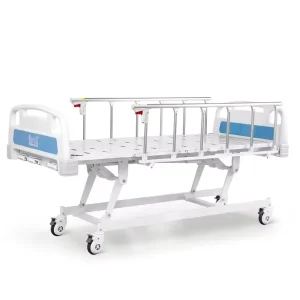
What Is a Cheap Single Function Manual Hospital Bed?
A cheap single function manual hospital bed (often called a 1-crank bed, one-function manual bed, or single-crank manual hospital bed) is a purpose-built medical bed that provides a single mechanical adjustment — most commonly the backrest (head section) elevation. Unlike electric or multi-function beds, it uses a simple, manually operated crank mechanism to change the patient’s position. “Cheap” here refers to affordability in purchase price and lifecycle costs while still meeting essential safety and durability requirements for clinical or homecare use.
Core components and how they work
-
Frame and Platform
-
Heavy-gauge steel or stainless steel frame forms the structural backbone.
-
The sleep surface is usually a ventilated steel slatted board or a bolted perforated deck which reduces weight and improves mattress ventilation.
-
The full load capacity typically ranges from 180 kg to 250 kg depending on gauge and welding.
-
-
Crank Mechanism (1-crank)
-
A single crank (handwheel) connects to a mechanical linkage beneath the bed deck.
-
Turning the crank converts rotational input into linear motion, lifting the head section smoothly to a preset angle range (commonly 0°–75°).
-
High-quality cranks use worm gears or sealed gearboxes to prevent backdrive and reduce wear; cheaper models use simpler linkages — still serviceable but with different longevity.
-
-
Headboard & Footboard
-
Frequently made from ABS engineering plastic (detachable) or simple powder-coated metal panels.
-
Detachable design helps logistics (shipping density) and replacement.
-
-
Side Rails & Safety
-
Foldable or removable side rails (aluminum or steel) for patient protection; rails help meet basic patient safety requirements.
-
Rail height and locking mechanisms are critical for fall prevention.
-
-
Castors / Mobility
-
Swivel castors (often 4, 5”/125mm) with central locking enable movement and immobilization.
-
Heavy-duty models use larger, sealed bearings for hospital corridors.
-
-
Accessory interfaces
-
Mounts for IV poles, overbed tables, or urine bag hooks are typically provided or available as options.
-
Typical functions & variants
-
Standard single-function: Head elevation only (most common and lowest cost).
-
Side variants: Some “single function” models offer the single action as either head elevation or knee elevation — ensure you confirm which function before ordering.
-
Entry-level vs. reinforced: Entry models use lighter gauge steel and basic cranks; reinforced models beef up frame and gearbox for bariatric use.
Materials & build quality — what to inspect
-
Frame gauge: 16–12 gauge steel is common; thicker for higher load capacity.
-
Surface finish: Powder coating resists corrosion; stainless steel is preferred in humid environments.
-
Crank material: Steel with anti-rust plating or zinc coating; plastic handles are acceptable but metal recommended for heavy use.
-
Deck type: Perforated/ventilated deck vs. solid board — ventilated is better for infection control and mattress breathability.
-
Fasteners & welds: Continuous welds and quality fasteners mean fewer squeaks and longer life.
Regulatory & quality considerations
-
While “cheap” models may not always carry premium certification, reputable suppliers (like Hengyuan Medical) provide CE, ISO 13485, or documented QC processes.
-
For institutional procurement, insist on material test reports, load testing data, and warranty terms (typical warranty: 12–24 months for mechanical parts).
Clinical and practical advantages
-
Affordability: Lower capital outlay and simpler maintenance budget.
-
Robustness: Fewer failure points compared to electric beds (no motors, fewer electronics).
-
Simplicity: Staff training is minimal; adjustment via crank is intuitive.
-
Power-independent: Useful in locations with unreliable electricity or for field/temporary hospitals.
Limitations and tradeoffs
-
Limited functionality: No height adjustment, which can make transfers and complex care tasks more labor-intensive.
-
Manual effort: Repeated crank use for many patients can be tiring for caregivers.
-
Lower advanced care suitability: Not ideal for ICU or very high dependency patients who need rapid, multi-axis repositioning.
Key use cases (where a cheap single function bed is ideal)
-
Homecare & assisted living — patients needing head elevation only.
-
Resource-constrained hospitals & clinics — when budget and maintenance capacity are limited.
-
Temporary & emergency facilities — rapid deployment without wiring or power needs.
-
Mass procurement for large wards — when replacing many beds economically.
Mattress compatibility & infection control
-
Use PU foam or waterproof medical mattresses sized to the bed frame; ventilated decks reduce moisture buildup.
-
For infection control choose wipeable, impermeable mattress covers and periodically disinfect the deck and rails; avoid mattress types requiring specialized frames.
Maintenance & lifecycle management
-
Routine checks: Crank smoothness, rail locks, castor bearings, and frame integrity monthly.
-
Spare parts strategy: Keep spare cranks, locking pins, rails, and a set of castors in stock to minimize downtime.
-
Expected service life: With routine maintenance, a good single-function bed will last 5–10 years in non-critical environments.
Procurement checklist (practical buying tips)
-
Confirm whether the single function is backrest or leg.
-
Verify load capacity (match anticipated patient weights + safety factor).
-
Ask for material certificates, sample photos, and assembly drawings.
-
Request lead times, packing dimensions (for freight), and MOQ if ordering factory direct.
-
Negotiate warranty and spare parts availability (local stocking is a plus).
Safety & risk notes
-
Always pair with appropriate nursing protocols: bed height (for transfers), side rails usage guidelines, and fall-risk assessments.
-
Ensure side rails meet local safety requirements; improper use of rails can increase entrapment risk.
Real-world example (brief)
A regional clinic ordered 120 Hengyuan Medical single-function manual beds for a new outpatient ward. By selecting ventilated deck decks, powder-coated frames, and central locking castors, they reduced procurement cost by 42% vs. two-function beds while maintaining acceptable patient comfort and easing logistics (smaller crate size per unit).
Short FAQ (quick answers for buyers)
-
Q: Is a single function bed medical-grade?
A: Yes — when sourced from reputable manufacturers and supplied with proper materials and QC documentation. -
Q: Can these beds be upgraded later?
A: Some frames accept bolt-on accessories; however, upgrading to motorized functions typically requires a different model. -
Q: How do I choose the right mattress?
A: Match mattress width/length to frame, prioritize waterproof and medium-firm PU foam for general use.
⭐ 2. Why Healthcare Facilities Choose Single Function Manual Beds
2.1 Cost-Effective & Long-Lasting
Manual hospital beds are far more affordable than electric or multi-function models.
No motors = no electrical maintenance = lower lifetime cost.
2.2 Perfect for Homecare & Basic Patient Use
Many patients, especially elderly users, need only the backrest adjustment, making single crank beds ideal.
2.3 Durable Steel Frame Construction
Hengyuan Medical uses:
-
Powder-coated steel bed frames
-
ABS headboard and footboard
-
Heavy-duty crank mechanism
ensuring high structural stability.
2.4 No Electricity Required
These beds are perfect for:
-
rural clinics
-
developing markets
-
areas with unstable power
-
emergency medical deployment
2.5 Easy Repair & Spare Parts Availability
All components—side rails, cranks, wheels, boards—are replaceable.
Why Healthcare Facilities Choose Single Function Manual Beds — A Deep Dive
Healthcare facilities select single function manual hospital beds (also called 1-crank beds, one function manual beds, or single-crank manual beds) for a mix of economic, operational, clinical, and logistical reasons. Below we unpack the full rationale — cost math, staffing & workflow impacts, maintenance and lifecycle, infection control, procurement strategy, and real-world deployment scenarios — so hospital administrators and procurement teams can make an evidence-based decision.
1. Cost & Return on Investment (ROI)
Capital cost is the dominant driver. Typical price ranges (estimates vary by region, manufacturer, and features):
-
Cheap single function manual hospital bed (basic): $120–$350 per unit (factory-direct, bulk).
-
Two-function manual bed: $250–$600.
-
Electric / three-function bed: $1,200–$5,000+.
Example ROI comparison for a small clinic buying 100 beds:
-
Purchase cost difference (single vs electric): assume single = $250, electric = $2,000 → upfront savings = $1,750 × 100 = $175,000.
-
Annual maintenance & power savings (no motors, no electronics): estimated $30–$60 per bed/year → for 100 beds ≈ $3,000–$6,000/year saved.
-
Break-even: if electric beds are not necessary clinically, the single function bed pays for itself almost immediately via CAPEX avoidance and reduced OPEX.
Key takeaway: For budget-constrained hospitals, nursing homes, or large bulk procurements, the cheap single function manual hospital bed delivers the highest cost-effectiveness per unit of clinical benefit.
2. Operational Simplicity & Workflow
Simplicity reduces training time: Staff learn to use a crank and fold rails within minutes, reducing onboarding time for temporary or rotating staff.
Fewer failure modes: Without motors, electronics, or control panels, manual beds have fewer points of failure. This translates into:
-
Less downtime — beds are usable until a simple mechanical part is replaced.
-
Reduced reliance on biomedical engineering teams for repairs.
-
Faster turnover for discharges and admissions in high-volume wards.
Ergonomics & labor:
-
Repeated crank operation can be physically demanding; however, many 1-crank mechanisms are designed with low-effort gearing.
-
For wards with heavy patient handling needs (frequent height changes, transfer assistance), a two-function or electric bed could reduce caregiver musculoskeletal strain. Therefore, choose single function where transfers are infrequent or handled by lifts/hoists.
3. Maintenance, Spare Parts & Total Cost of Ownership
Manual beds shift the maintenance model from electrical servicing to simple mechanical upkeep:
-
Common spare parts: cranks, lock pins, castors, side-rail hinges, fasteners, ABS panels.
-
Routine checks (monthly): crank smoothness, rail locking integrity, castor function, weld integrity, paint/coating wear.
-
Repair time: Most mechanical fixes can be performed by general maintenance staff in under an hour.
Inventory strategy: For facilities adopting many manual beds, keep an on-site kit with 5–10% spare parts (cranks, castors, lock pins). This minimizes bed OOS (out-of-service) time.
Lifecycle: With routine maintenance, a well-built single function manual bed typically lasts 5–10 years in non-critical settings — comparable lifecycle to more complex beds when factoring repair costs.
4. Infection Control & Cleaning
Manual beds can have advantages for infection control when designed properly:
-
Ventilated deck design reduces moisture accumulation beneath the mattress — important for preventing mold and bacterial growth.
-
ABS headboards and smooth powder-coated steel frames are easy to wipe and disinfect; fewer crevices than beds with electric motors and control boxes.
-
Mattress compatibility: Use waterproof, wipeable mattress covers and PU foam or medical-grade mattresses for rapid surface decontamination.
Cleaning protocols: disinfect rails, crank handle, castors, and head/foot panels between patients. Because there are no electrical enclosures, cleaners can use a broader range of disinfectants without risk of component damage.
5. Clinical Suitability — Where Single Function Works Best
Appropriate settings:
-
General wards where only head elevation is required for feeding, respiratory comfort, or basic care.
-
Homecare & assisted living where patients mostly need positional support.
-
Temporary or field hospitals due to rapid deployment and no power requirement.
-
Budget replacement programs for developing regions or non-critical wards.
Not recommended for: ICU, high dependency, perioperative, or bariatric care that requires frequent, rapid repositioning, elevation, or height adjustments.
6. Logistics, Shipping & Storage Benefits
Manual beds generally ship with smaller packing volume (detachable ABS panels, collapsible rails), which reduces freight costs — especially relevant for international tenders or NGO procurement.
-
Example: Collapsed pack sizes allow more units per container → lower per-bed shipping cost.
-
On-site assembly: Simple bolt-on designs make assembly fast with minimal tools.
7. Procurement Strategy & Total Value Assessment
When procuring, evaluate beyond unit price:
-
Unit price vs. lifecycle cost: Consider maintenance, spare parts, cleaning, and staff time.
-
Clinical needs matrix: Map wards by clinical requirements (ICU vs general vs homecare) and assign bed types accordingly.
-
Supplier reliability: Prioritize manufacturers (e.g., Hengyuan Medical) that provide documentation, sample testing, and spare parts supply.
-
Bulk negotiation: MOQ and factory-direct pricing can reduce per-unit cost significantly for manual beds.
Sample procurement matrix (simple):
| Ward Type | Clinical Need | Recommended Bed |
|---|---|---|
| ICU | Multi-axis repositioning, pressure relief | Electric / 3-function |
| General Ward | Occasional head elevation | Single function manual bed |
| Homecare | Basic backrest adjustment | Single function manual bed (retail versions) |
| Emergency Field Hospital | Rapid deploy, no power | Single function manual bed |
8. Staffing, Safety & Ergonomic Considerations
-
Caregiver fatigue: If caregivers must frequently adjust beds manually for many patients, evaluate crank gearing or consider semi-mechanized models.
-
Training: Even though operation is simple, train staff on safe use of side rails (entrapment risks) and fall prevention protocols.
-
Patient safety: Confirm side rail designs meet local regulations; improper rail use is a safety hazard.
9. Real-World Deployment Examples (Operational Insights)
-
Large municipal hospital: Switched 300 general ward beds from older electric models to 1-crank manual beds for new low-acuity ward — freed budget for monitoring equipment and reduced maintenance load.
-
NGO field deployment: Chose manual beds for refugee camps due to no power reliance; benefited from easy cleaning and rapid assembly.
-
Homecare retailer: Carried a Hengyuan Medical single function model as the top seller for low-cost home hospital solutions — combined with waterproof mattresses and overbed tables as a packaged set.
10. Decision Checklist — Should You Choose Single Function Beds?
Ask these questions:
-
Do patients require height adjustment or leg elevation often? → If yes, consider 2-function or electric.
-
Is the facility limited by CAPEX? → Single function is favorable.
-
Is electricity unreliable or unavailable? → Single function is ideal.
-
Can staff handle manual adjustments for the expected patient volume? → If high turnover and many adjustments daily, evaluate caregiver ergonomics.
-
Is spare parts supply/logistics manageable? → Confirm supplier (e.g., Hengyuan Medical) offers parts and reasonable lead times.
Summary — The Bottom Line
The cheap single function manual hospital bed is a pragmatic choice for facilities prioritizing cost-effectiveness, low maintenance, simple logistics, and robustness. It is not a universal solution, but when aligned with patient acuity and operational realities, it provides compelling economic and functional value. For many hospitals, clinics, homecare providers, and emergency deployments, the single-crank manual bed remains the best-fit balance between affordability and clinical utility.
⭐ 3. Technical Specifications (Hengyuan Medical Standard)
为了覆盖全部关键词,我将扩展一个超完整技术表格(可直接放在你网站)。
| Item | Specification |
|---|---|
| Model Name | Hengyuan Medical Single Function Manual Hospital Bed |
| Function | 1-crank backrest adjustment (0°–75°) |
| Bed Platform | Powder-coated steel, ventilated bed board |
| Headboard/Footboard | ABS engineering plastic, detachable |
| Side Rails | Aluminum or ABS foldable guard rails |
| Crank System | Heavy-duty manual crank, anti-rust design |
| Load Capacity | 180–250 kg |
| Mattress Compatibility | PU or waterproof foam mattress |
| Caster Wheels | 5” silent wheels with central locking |
| Optional Accessories | IV stand, overbed table, infusion chair, hospital mattress |
| Applications | Hospitals, clinics, homecare, nursing facilities, medical wards |
| Category Keywords | manual hospital beds, single crank bed, hospital furniture, patient care bed, home hospital bed |
⭐ 4. Case Study: How Hospitals Use Single Function Beds
Case 1 — Community Health Center, Southeast Asia
A customer from a rural medical project needed 800 sets of cost-effective beds.
Electric beds exceeded the budget, so Hengyuan Medical recommended:
✔ Single function manual beds
✔ Economic mattresses
✔ IV poles + guard rails
The project saved 37% cost while improving service capacity.
Case 2 — Homecare Distributor in South America
A distributor required hospital beds for homecare use.
Most patients needed only:
-
backrest adjustment
-
durable steel frame
-
affordable retail price
The 1-crank manual bed became their top-selling model, competing against Amazon-listed models while offering better durability.
Case 3 — Emergency Hospital Deployment in Europe
During a pandemic surge, a temporary medical center purchased:
✔ 500 manual adjustable hospital beds
✔ 200 economic hospital stretchers
Because these beds do not require electricity, they were ideal for rapid installation.
⭐ 5. Comparison: Single Function vs. Multi-Function Beds
| Feature | Single Function (1-crank) | Two Function | Three Function |
|---|---|---|---|
| Backrest adjustment | ✔ | ✔ | ✔ |
| Leg/height adjustment | ✘ | ✔ | ✔ |
| Price | Lowest | Medium | Highest |
| Maintenance | Very Easy | Easy | Complicated |
| Ideal for | Homecare, small clinics | Hospitals | ICU, long-term care |
Conclusion:
For projects focusing on budget, basic patient needs, and large quantities, the cheap single function manual hospital bed remains the most cost-efficient option.
⭐ 6. Buying Guide: How to Choose the Right Manual Hospital Bed
6.1 Determine the Required Function
If basic back adjustment is enough → single function is best.
If you need height movement → choose 2-function.
6.2 Choose Frame Material
Hengyuan Medical offers:
-
Steel powder-coated frame
-
Stainless steel options for humid climates
-
ABS head/foot boards for safety
6.3 Check the Crank Mechanism
A durable mechanical crank is key.
Look for:
-
anti-rust
-
smooth rotation
-
noise-free mechanism
6.4 Confirm Certifications
Depending on the market:
-
CE
-
ISO13485
-
FDA (optional)
6.5 Accessories Worth Considering
To increase revenue per bed set:
-
hospital mattress
-
side rails
-
IV stand
-
overbed table
-
infusion chair
-
emergency crash cart
-
steel trolley
-
stainless steel mayo table
All属于 hospital furniture 相关词,可提升 SEO 相关性。
⭐ 7. Why Choose Hengyuan Medical?
Hengyuan Medical offers a full line of manual hospital beds:
-
single function manual bed
-
1 crank bed
-
manual adjustable bed
-
homecare beds
-
budget hospital furniture
Advantages:
✔ Factory-direct price
✔ 15+ years manufacturing experience
✔ OEM/ODM capability
✔ Global hospital projects
✔ Complete hospital furniture supply chain
