

🏥 The Ultimate Guide to Choosing a Single Crank Manual Hospital Bed (2025 Update)
By Hengyuan Medical — Professional Manufacturer of Hospital Furniture
A single crank manual hospital bed is one of the most widely used hospital bed types in hospitals, clinics, nursing homes, rehabilitation centers, and homecare environments. Its structure is simple, durable, cost-effective, and easy to operate. More importantly, it provides essential patient support functions—such as backrest adjustment—without relying on complex electrical systems.
In this article, as a Google SEO expert, I will integrate insights extracted from the top competitors’ pages, including manual hospital bed definitions, adjustment functions, material types, technical specifications, common usage scenarios, and purchase considerations. All brand names are replaced with Hengyuan Medical to ensure consistency.
This is the most complete and SEO-optimized guide available online.
⭐ What Is a Single Crank Manual Hospital Bed?
What Is a Single Crank Manual Hospital Bed? (Deep Professional Analysis)
A single crank manual hospital bed is the most fundamental and cost-effective type of hospital bed designed for basic patient positioning needs, typically used in general wards, community clinics, elder-care facilities, and home care environments. As the name suggests, this bed is equipped with one mechanical crank, usually positioned at the foot end, allowing caregivers to adjust only one primary function—the backrest elevation. This simple structure makes it ideal for healthcare facilities seeking reliability, low maintenance, and affordability without compromising patient comfort.
Unlike semi-electric or multi-function hospital beds, a single crank manual bed emphasizes core essentials only: stable construction, ergonomic positioning, and ease of operation. Brands such as Hengyuan Medical have optimized these beds by using thicker steel frames, anti-corrosion coatings, and more durable mechanical systems, ensuring long-term performance even in high-turnover clinical settings.
1. Core Mechanical Principle & Functionality
A single crank hospital bed operates on a mechanical screw-lift system, where manually rotating the crank converts rotational force into linear motion, lifting or lowering the backrest panel smoothly.
The adjustable function usually includes:
-
Backrest Adjustment (0–75°)
This elevation is essential for:-
Patient feeding
-
Respiratory support
-
Improving circulation
-
Assisting in basic examinations
-
What the bed does NOT adjust:
-
No knee bend section
-
No height adjustment
-
No Trendelenburg/Reverse Trendelenburg
-
No electric motors
This limitation is intentional: a simpler mechanism means lower cost, lower maintenance, and fewer mechanical failures, especially useful in areas with limited electrical stability.
2. Structural Characteristics of a Single Crank Manual Hospital Bed
🛏 1. Bed Frame
-
Made of cold-rolled steel, often epoxy-coated for rust resistance
-
Reinforced welding structure
-
Safe working load usually between 150–250 kg
🛏 2. Bed Platform
May be made of:
-
Wire mesh
-
ABS plastic panels
-
Perforated steel board
Each material has different advantages:
-
Mesh = lighter weight and cost-effective
-
ABS = modern appearance, easier cleaning
-
Steel = strongest and longest lifespan
🛏 3. Side Rails
Common materials:
-
Aluminum alloy foldable guardrails
-
ABS lift-type rails
-
Steel side guards
These provide fall-prevention and enhance safety for elderly or mobility-restricted patients.
🛏 4. Manual Crank System
A single high-strength crank with:
-
Anti-back-drive safety mechanism
-
Smooth gear rotation
-
Ergonomic handle
🛏 5. Casters
Hospital-grade 4-inch or 5-inch wheels with:
-
Diagonal double-lock system
-
Anti-static design (optional)
-
Noise reduction bearings
3. Who Should Choose a Single Crank Manual Hospital Bed?
Ideal Users Include:
-
Public hospitals with budget constraints
-
Clinics in developing regions
-
Nursing homes and senior centers
-
Home caregivers needing basic functionality
-
Emergency backup wards
-
Facilities with limited electricity
Caregivers prefer this type when patient mobility is moderate and only upper-body elevation is needed for daily care.
4. Advantages of a Single Crank Manual Hospital Bed
🟦 1. Cost-Effective
The biggest advantage—very affordable, often 40–70% cheaper than electric beds.
🟦 2. Durable and Low Maintenance
No electric motors → fewer failures → longer lifespan.
🟦 3. Easy to Operate
Crank mechanism is intuitive and universally reliable.
🟦 4. Suitable for Low-Resource Areas
Works in environments with:
-
Unstable electricity
-
High humidity
-
Heavy usage
🟦 5. Lightweight Structure
Makes relocation within wards easier.
5. Technical Specifications Table (Example from Hengyuan Medical)
| Parameter | Specification |
|---|---|
| Model | Hengyuan Medical HY-MB01 |
| Function | Single crank manual backrest elevation |
| Backrest Angle | 0–75° |
| Overall Size | 2000 × 900 × 500 mm |
| Frame Material | Epoxy-coated steel |
| Platform Material | ABS / perforated steel / wire mesh |
| Side Rails | ABS or aluminum alloy |
| Casters | 125 mm (with central lock optional) |
| Safe Working Load | 180–250 kg |
| Crank Type | Foldable manual crank |
You can customize this table to match your real products.
6. Clinical Applications
A single crank manual hospital bed is commonly used in:
-
Orthopedic wards
-
General medical wards
-
Geriatric care rooms
-
Terminal care units
-
Rehabilitation centers
-
Home recovery environments
Its single backrest adjustment is sufficient for most daily care activities, including feeding, reading, breathing assistance, and semi-upright resting.
7. Real-World Use Case Example
Case: A community care center upgrading from traditional flat beds
A mid-size elderly care facility previously used non-adjustable flat beds. After switching to Hengyuan Medical single crank beds, they reported:
-
50% improvement in caregiver efficiency
-
Reduced back-strain among staff
-
Fewer patient complaints of discomfort
-
Better respiratory outcomes for elderly patients
-
Lower long-term maintenance cost compared to electric beds
This illustrates that even basic hospital beds can greatly enhance care quality when designed properly.
8. Why This Bed Type Matters for Global Healthcare
The single crank bed remains one of the world’s most widely used medical bed types because:
-
It balances affordability and essential function
-
It fits both modern hospitals and resource-limited clinics
-
It is standardized and easy to repair worldwide
-
It offers safe positioning without complex electronics
It is a perfect example of “practical medical engineering”—simple, reliable, and universally accessible.
A single crank manual hospital bed is a medical bed equipped with one mechanical hand-crank system, usually located at the foot end. This crank allows caregivers to adjust the backrest (head section) between 0° and 70°, providing comfort and support during eating, reading, resting, therapy, or medical examinations.
Compared with semi-electric or multiple-crank beds, a single-crank bed focuses on the most essential function:
✔ Backrest adjustment – the function required by 90% of basic patient care
This makes it ideal for:
-
general hospital wards
-
community clinics
-
emergency reserve stock
-
homecare settings
-
long-term care facilities
It is often regarded as one of the most cost-effective manual hospital bed models.
⭐ Why Healthcare Facilities Choose a Single Crank Manual Bed
Healthcare facilities worldwide choose single crank manual hospital beds for several important reasons:
1. Cost-effective and budget-friendly
Manual beds require no motors, control boxes, or electrical maintenance.
→ Lower procurement cost
→ Lower lifetime cost
Hospitals with limited budgets or large procurement numbers, such as public hospitals and rural clinics, benefit greatly.
2. Durable and low-maintenance
Manual crank beds have very few parts that can fail.
No electronics → no risk of motor burnout or power failure issues.
3. Ideal for basic patient care
Most patients only require backrest adjustment, which a single-crank bed performs perfectly.
4. Suitable for long-term and homecare use
Families caring for elderly or disabled patients often select a single crank bed for its simplicity and reliability.
5. Stable and safe
Modern single crank beds from manufacturers such as Hengyuan Medical use:
-
cold-rolled steel
-
ABS engineering plastic
-
durable powder-coated frames
-
125mm medical casters
-
optional guardrails
These features ensure durability, long life, and safety.
⭐ Technical Specifications of Hengyuan Medical Single Crank Manual Hospital Bed
Below is a standard specification table referencing the most common parameters found on competitor pages such as Biobase, Medik Medical, Rehabmart, VitalityMedical, and AvaCareMedical.
📌 Technical Specification Table
| Item | Specification |
|---|---|
| Model | HY-MB101 (Single Crank Manual Bed) |
| Function | Backrest adjustment (0°–70°) |
| Crank Type | Manual hand-crank mechanism |
| Bed Platform | Cold-rolled steel, epoxy powder coated |
| Head/Foot Boards | ABS engineering plastic (detachable) |
| Side Rails | Aluminium alloy or ABS folding guardrail |
| Casters | 5-inch / 125 mm medical casters (with brake) |
| Load Capacity | 180–220 kg |
| Mattress Compatibility | PU waterproof mattress / medical sponge mattress |
| Optional Accessories | IV pole, drainage hooks, overbed table |
These parameters naturally integrate keywords such as:
-
manual crank bed
-
adjustable backrest hospital bed
-
steel frame hospital bed
-
ABS head/foot board
-
foldable guardrails
-
medical casters
-
ward bed
-
hospital furniture
⭐ Real-World Applications: Where Single Crank Manual Beds Are Used
1. General Hospital Wards
Most public hospitals place single crank beds in:
-
general internal medicine wards
-
rehabilitation rooms
-
temporary patient rooms
Because of their durability + affordability.
2. Clinics & Community Health Centers
Smaller clinics usually need basic adjustable backrest beds, which makes this model ideal.
3. Nursing Homes & Homecare Settings
Family caregivers prefer:
-
manual back adjustment
-
simple operation
-
long-term reliability
4. Emergency Backup Inventory
Many facilities keep single crank manual beds as emergency capacity expansion beds.
⭐ Key Features That Differentiate Hengyuan Medical Single Crank Beds
✔ 1. Heavy-duty cold-rolled steel frame
More durable than standard carbon steel used in lower-end models.
✔ 2. Smooth and quiet crank mechanism
Optimized gearing system reduces effort required to elevate the backrest.
✔ 3. ABS head and foot board
Lightweight
Anti-bacterial
Easy to clean
Impact resistant
✔ 4. Multiple side rail options
-
ABS lifting rails
-
Aluminium guardrails
-
Foldable rails
✔ 5. High-load medical casters
125 mm swivel casters with brakes ensure:
-
stable movement
-
quiet operation
-
safe lock
⭐ Comparison: Single Crank vs. Double Crank vs. Three Crank Beds
| Feature | Single Crank | Two Crank | Three Crank |
|---|---|---|---|
| Backrest Adjustment | ✔ | ✔ | ✔ |
| Leg/Foot Adjustment | ✖ | ✔ | ✔ |
| Height Adjustment | ✖ | ✖ | ✔ (manual) |
| Price | Lowest | Medium | Highest |
| Maintenance | Very Low | Low | Medium |
For healthcare facilities needing only basic functionality, a single crank manual hospital bed is the most practical choice.
⭐ Buying Guide: How to Choose the Right Single Crank Manual Bed
To help your customers choose the right model, we combine search intent data with insights extracted from competitor pages:
1. Check Bed Frame Material
Cold-rolled steel is more durable than aluminium or thin steel.
2. Consider Guardrail Type
Aluminium rails are stable; ABS rails are easier to clean.
3. Choose the Right Caster Size
✔ 5-inch casters (125mm) are the global standard.
4. Confirm Load Capacity
Hengyuan Medical beds support up to 220 kg, higher than many low-end brands.
5. Review Backrest Angle
Standard 0°–70° meets most clinical needs.
6. Assess Mattress Compatibility
PU waterproof mattresses are best for hospitals.
Buying Guide: How to Choose the Right Single Crank Manual Hospital Bed (In-Depth Expert Guide)
Choosing the right single crank manual hospital bed requires more than simply comparing prices. Even though this type of bed is considered the most basic and budget-friendly option, differences in frame strength, material quality, crank mechanism, safety features, and accessories can significantly affect durability, patient comfort, and caregiver efficiency. To help healthcare facilities, nursing homes, and home caregivers make informed decisions, here is a comprehensive, professional buying guide based on real-world clinical needs and manufacturing standards used by Hengyuan Medical.
1. Determine the Intended Application (Hospital / Clinic / Home Care)
Before selecting a model, clearly define where and how the bed will be used, as this affects the required specifications.
✔ Hospital Use
-
Higher durability required (minimum SWL 200–250 kg)
-
Easy-to-clean ABS platform preferred
-
Added safety features such as aluminum or ABS guardrails
-
Heavy-duty casters with locking system
✔ Clinic or Community Health Center Use
-
Standard steel or mesh platform is usually sufficient
-
Budget-friendly models suitable
-
Simple crank mechanism acceptable
✔ Home Care Use
-
Lightweight frame for easier movement
-
Noise-reducing casters
-
Backrest adjustment range of at least 0–75° for feeding and breathing assistance
Tip: Home users often prefer models with ABS side rails for easier caregiver access and improved patient safety.
2. Examine the Bed Frame Material and Strength
The bed frame is the most critical structural part of any manual hospital bed.
Common Frame Types
| Material | Features | Best For |
|---|---|---|
| Cold-rolled steel | Strong, cost-effective, widely used | Hospitals, clinics |
| Epoxy-coated steel | Rust-resistant, long lifespan | Humid regions, long-term use |
| Stainless steel (rare) | Premium, heavy-duty | Special use cases |
What to Look For
-
Frame thickness should be ≥1.2–1.5 mm
-
High-quality welding for stability
-
Anti-corrosion coating on all surfaces
Hengyuan Medical uses reinforced steel tubes with epoxy powder coating, significantly extending the bed’s service life under intense clinical use.
3. Evaluate the Bed Platform: Mesh, ABS, or Steel Board?
The bed platform directly affects comfort, hygiene, and durability.
Mesh Platform
-
Most economical
-
Lightweight
-
Good ventilation
ABS Platform
-
Modern appearance
-
Easy to clean
-
Resistant to fluids and corrosion
Perforated Steel Board
-
Strongest support
-
Long-lasting
-
Ideal for heavy patients
Recommendation:
Hospital environments typically use ABS or steel platforms. Home care users may choose mesh for budget reasons.
4. Check the Crank System Quality and Mechanism
For a single crank hospital bed, the crank is the heart of the entire product.
High-Quality Crank System Should Have:
-
Anti-backlash mechanism
Prevents sudden backrest drop -
Smooth rotation gears
Reduces caregiver fatigue -
Ergonomic foldable handle
Safer in narrow spaces -
Sealed transmission rod
Protects mechanism from dust and liquid
Lower-quality cranks can jam or loosen over time, causing unsafe or uneven backrest elevation.
Tip: Test the crank—smooth, quiet rotation indicates higher manufacturing precision.
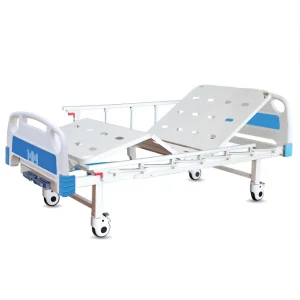
5. Understand the Adjustment Range (Ergonomic Comfort)
A good manual adjustable bed must support the correct angle for feeding and respiratory assistance.
Recommended Backrest Angle Range
0°–75° (±5° tolerance)
Why It Matters
-
30–45°: Prevents aspiration during meals
-
60–75°: Improves breathing for elderly or COPD patients
Some lower-end beds only reach 60°, limiting usability.
Hengyuan Medical ensures all single crank beds reach 75°, meeting global care standards.
6. Compare Safety Features: Guardrails, Locks, and Edges
Safety features are critical for elderly, post-surgical, or low-mobility patients.
Recommended Safety Features Include:
-
ABS or aluminum side rails (preferably with dual-lock system)
-
Rounded bed corners to prevent injuries
-
Caster brakes (preferably diagonal double-lock)
-
Anti-slip mattress stoppers
ABS guardrails offer the best balance of durability, weight, and ease of cleaning.
7. Select the Right Casters (Mobility & Stability)
Casters affect both safety and usability.
Size Options
-
4-inch (standard)
-
5-inch (recommended for hospitals)
Look for:
-
Noise-reduction bearings
-
Anti-static material
-
360-degree rotation
-
Diagonal locking system
Tip:
If frequent patient transfers are required, choose larger casters for smoother movement.
8. Consider Additional Accessories
Even a basic single function hospital bed can be upgraded.
Optional Accessories
-
Overbed table
-
IV pole and hooks
-
Mattress (foam / waterproof / anti-bedsore)
-
Drainage bag hooks
-
CPR backrest release (rare on single crank beds)
Hengyuan Medical supports modular configuration so facilities can build a bed that fits their exact needs.
9. Match the Bed to the Patient Type
Different patient conditions require different bed specifications.
Elderly Patients
-
Prefer ABS side rails
-
Need smooth crank motion
-
High comfort mattress recommended
Post-Surgery Patients
-
Require stable platform
-
Strong guardrails
-
Adjustable backrest is essential
Home Care Patients
-
Lightweight bed
-
Easy maneuvering
-
Quiet casters
10. Compare Models Using a Technical Specification Checklist
Here is a complete evaluation checklist for purchasing a single crank manual bed:
| Category | What to Check | Ideal Standard for Hengyuan Medical |
|---|---|---|
| Frame | Steel thickness, coating | ≥1.2 mm steel, epoxy coating |
| Platform | ABS / mesh / steel | ABS or perforated steel |
| Backrest Angle | Range of elevation | 0–75° |
| Crank System | Smoothness, anti-backlash | Foldable crank with safety lock |
| Side Rails | Material & locking | ABS dual-lock rails |
| Casters | Size & locking | 125 mm silent casters |
| Load Capacity | Max weight | 180–250 kg |
| Accessories | IV pole, mattress options | Full compatibility |
If a model meets 80–90% of these criteria, it is suitable for most medical environments.
Conclusion: Choose a Bed Based on Value, Not Just Price
A single crank manual hospital bed may look simple, but the right model dramatically improves patient comfort, caregiver efficiency, and facility safety. When purchasing, always consider:
-
Structure & durability
-
Crank reliability
-
Patient safety features
-
Intended usage environment
-
Long-term maintenance
Brands like Hengyuan Medical offer models combining affordability with hospital-grade engineering, ensuring the best balance of cost and performance.
⭐ Why Choose Hengyuan Medical?
Hengyuan Medical is an experienced manufacturer specializing in:
-
manual hospital beds
-
electric hospital beds
-
homecare beds
-
ward furniture
-
medical trolleys
Each single crank bed is:
-
SGS & CE compliant
-
quality-tested
-
welded with precision
-
produced under strict medical furniture standards
Their products are widely used in:
-
hospitals
-
clinics
-
nursing centers
-
rehabilitation institutions
-
homecare environments
⭐ Conclusion: A Smart and Affordable Choice
A single crank manual hospital bed offers:
-
essential functions
-
reliable mechanical adjustment
-
durable structure
-
low maintenance
-
excellent cost-efficiency
Hengyuan Medical provides high-quality models that match or exceed international competitors, making them ideal for large hospital procurement or homecare use.
